Local Highways Improvements
Wistow Parish Council is applying for Local Highways Improvements Funding. Following feedback from the community via our annual survey, the main issue that the community is concerned with is speeding in the village, mainly along Mill Road to cut through to other villages.
Published: 1 December 2025
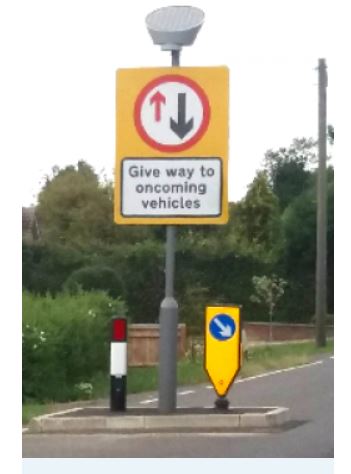
Wistow Parish Council is looking to apply for funding for road narrowing to slow down the vehicles entering and leaving Mill Road. Please see the below details about road narrowing provided by Cambridgeshire County Council. We need to gather feedback from the community in support of this funding and we would appreciate it if you could click here to register your interest.
Priority narrowings require one direction of traffic to give way to oncoming vehicles. The narrowing consists of a build out and bollard in one half of the road or built out slightly from both sides, with a sign to show who has priority. For the lane without priority, there are Give Way markings on the approach.
Groups of narrowings can be placed with alternating priority down a road, so that each direction of vehicle traffic may have to stop and give priority in equal measures.
Effectiveness
Priority narrowings are a horizontal treatment which can reduce vehicle speeds. Vertical treatments – such as speed cushions or speed tables – are more effective at consistently keeping speeds lower over a longer length.
Reducing vehicle speeds increases safety because:
- The vehicle has travelled a shorter distance by the time a driver can react to a hazard
- Braking distance is reduced, so the vehicle can stop more quickly before a hazard
- Higher speed crashes tend to result in higher severity injuries
Advantages of priority narrowing
- Do not cause any vehicle passenger discomfort (in comparison to vertical treatments)
- If there is sufficient road width they can be designed to allow cyclists to bypass them
- Emergency vehicles may be able to travel faster around a narrowing compared to vertical treatments
Disadvantages of priority narrowing
- Motor vehicles with priority are not required to reduce their speed
- Motor vehicles without priority are not required to reduce their speed if there is no oncoming vehicle approaching
- Motor vehicles without priority may race to the chicane before an oncoming vehicle approaches, or swerve dangerously around the chicane
- Where traffic flows are low or tidal there is very little speed reducing benefit as drivers rarely have to give way
- Where there is little need to give way drivers become used to not stopping and may fail to stop when necessary
- May cause long delays if there is increased vehicle traffic
- Buses without priority will find it more difficult to find a gap in vehicle traffic and drive around chicanes
- Some traffic is likely to transfer onto alternative routes, potentially causing a problem somewhere else
- Drivers may try to pass a cyclist through the narrowing which could cause a collision
- Can cause vehicle noise as vehicles stop and start
- Stop-start movements may increase vehicle exhaust emissions
- Managing water drainage could be complex and costly
Considerations
- May cause traffic to divert to other routes
- Priority narrowings could create motor vehicle noise which is heard in residences nearby, as many vehicles will be stopping and starting.
- May also have an adverse effect on air quality
- Good visibility to the feature and beyond is needed or drivers may approach too fast and be unable to stop in time
- Priority narrowings are normally used in residential areas
- Probably not appropriate for local distributor roads
- This scheme requires a Traffic Regulation Order and a Road Safety Audit.
Cost of installation
- £17,500 for a single narrowing feature.
- £25,000 for a pair of narrowing features.
The give way chicanes cost is based on give way build out(s), installed under two-way lights. There is no provision for drainage or additional street lighting.